Overview
Neuroscientists presume – and rightly so! – that brain function does not violate the laws of nature. We take it for granted that our mental functioning is dependent upon — it is subserved by — aspects of the natural world that are studied in the sciences of neurophysiology, chemistry, and physics. Similarly, the computation performed by modern digital computers does not violate the laws of nature. But the belief (perhaps tautology?) that the laws of nature apply to complex systems, and even living systems, does not inevitably lead to a reductionist view of mentality. At least, that is my view.
Functional isomorphism is a key concept in the philosophy of mind that was inherited during the “cybernetics moment” when neuroscience was in its infancy. In “Philosphy and our mental life,” Hilary Putnam explains that two systems are functionally isomorphic if there is a correspondence between the states of one and the states of the other that preserves functional relations. The concept of isomorphism pervades mathematics and is illuminated by answering the question, “What makes two mathematical structures essentially equivalent?”
Assignment
- Review the wiring diagram (shown in class) that summarizes the basic plan of the central nervous system of mammals (see blog page The Organization of the Brain). (15 min)
- Read the blog page The Problem of Qualia. (15 min)
- Read Putnam (1975). Philosophy and our mental life. In: Philosophical Papers, Vol. 2, Ch 14, pp. 134–143. [PDF] (60 min)
- Notebook/Blackboard Writing Prompts
- Write out 3 notable quotations from Putnam’s essay, 2 observations, and 1 question. Come to class ready to share and discuss these quotes, observations, and questions. (30 min)
- Write out working definitions (50 words each or so) for “representation,” “functional organization,” “qualia,” and “computation” as neuroscientists use these terms. (30 min)
In-class discussion: What does Hilary Putnam mean by functional isomorphism?
The concept of isomorphism – a structure preserving map (morphism) – arises in every branch of mathematics. For example, in graph theory (graph meaning network) an isomorphism between two graphs is a map that preserves the structural connectivity.

What does Putnam mean when he says that the concept of functional isomorphism “is key to unraveling the mysteries of the philosophy of mind”?
Putnam argues that mentality is a real and autonomous feature of the world. We know this quite apart from any philosophical or religious considerations regarding our substance (are we matter or something more?). Whatever our mental functioning may be, there is no reason to believe that it is explainable by our physics and chemistry.
Any workable psychological theory of a human being, or even a functional description of a computing machine or other complex systems (e.g., the economy), will focus on higher levels of structural and functional organization, not the ultimate constituents.
But, as Jerome Lettvin said, “you do not have to be a mystic” to say “No!” to uncompromising philosophical reductionism.
The crux of the matter seems to be that both the Diderots of this world and the Descartes of this word have agreed that if we are matter, then there is a physical explanation for how we behave, disappointing or exciting. I think the traditional dualist says “wouldn’t it be terrible if we turned out to be just matter, for then there is a physical explanation for everything we do“. And the traditional materialist says “if we are just matter, then there is a physical explanation for everything we do. Isn’t that exciting!” … I think they are both wrong. I think Diderot and Descartes were both wrong in assuming that if we are matter, or our souls are material, then there is a physical explanation for our behavior. (Putnam 1975)
Further reading
Philosophical Papers, Volume 2: Mind, Language and Reality (from which or reading was drawn) is a collection of Hilary Putnam’s work. [Amazon] [SWEM]
Edward Kelly and Emily Williams Kelly (2009). Irreducible Mind: Toward a Psychology for the 21st Century. Rowman & Littlefield Publishers. [Amazon] [SWEM]
Randall E. Auxier, Douglas R. Anderson, Lewis Edwin Hahn, eds. (2015). The Philosophy of Hilary Putnam. Open Court. [Amazon] [SWEM]
Joel B. Green (2008). Body, Soul, and Human Life: The Nature of Humanity in the Bible Baker Academic. [Amazon]
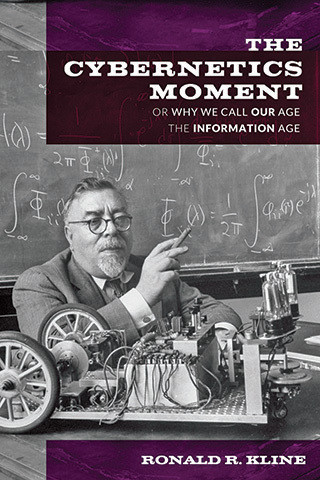
Kline, R. R. (2015). The Cybernetics Moment: Or why we call our age the information age. JHU Press.
 Computational Neuroscience
You must be logged in to post a comment.